

Listen to Pollyanna — Mondays & Saturdays at 12 PM
Updated: Sep 9
THE FELICITY STATION • MUSICAL STORY BOOKS
Listen to Pollyanna as an entire book told through music — streaming only on The Felicity Station every Monday and Saturday at 12:00 PM Melbourne time.
This is not a stage musical or a handful of songs inspired by the book. The Felicity Station tells the story chapter by chapter through original songs, turning the complete journey into a musical book you can hear from beginning to end.
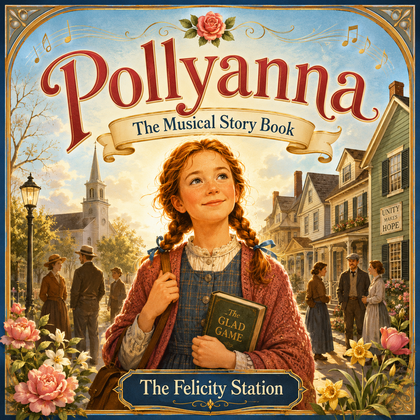
Pollyanna, by Eleanor H. Porter, follows a girl whose Glad Game begins as a way of surviving disappointment and gradually changes the people around her. The song titles follow that movement: from emptiness and duty, through connection and joy, into crisis, recovery and a final return to the idea that started it all.
Tune in at 12:00 PM Melbourne time on Mondays and Saturdays and hear Pollyanna — the whole story, told in music.
Pollyanna — Complete Song List
The complete musical book currently contains 24 completed songs. Each title marks a particular emotional turn in the story as the chapters move forward.
Empty Spaces — Chapter 1. The opening title establishes absence before Pollyanna arrives: rooms, relationships and lives with something missing, waiting to be filled.
The Burden of Duty — Chapter 2. “Duty” sounds respectable, but “burden” exposes how obligation can become a substitute for warmth and affection.
Almost Awake — Chapter 3. The title suggests a household and its people beginning to stir emotionally, even before they fully understand what Pollyanna will change.
As Near to Heaven — Chapter 4. A title built around wonder: Pollyanna can take an imperfect place and see elevation, possibility and beauty in it.
The Game — Chapter 5. This is the central idea of the entire musical book: the Glad Game becomes the mechanism through which Pollyanna interprets hardship and teaches others to look again.
Breathing Isn’t Living — Chapters 6–7. The title draws a line between merely existing and actually engaging with life, people, movement and hope.
Mrs. Snow’s Shade — Chapters 8 and 10. “Shade” gives the song a deliberately darker emotional colour, placing Pollyanna’s brightness against a more settled habit of pessimism.
Look Up — Chapter 9. One of the simplest titles is also one of the clearest statements of Pollyanna’s method: redirect attention from what is immediately wrong toward what can still be seen.
Somewhere Nowhere — Chapter 11. The contradiction in the title captures displacement and uncertainty — being physically somewhere while still feeling as though you belong nowhere.
Stay — Chapter 13. A single-word title turns the story toward attachment: beneath all the optimism is the very human desire to be wanted and allowed to remain.
Better Than — Chapters 14–15. The unfinished comparison is intentional: the Glad Game repeatedly asks what can be found that is better than the disappointment first placed in front of us.
The Mirror — Chapter 16. Reflection becomes both literal and emotional — how people see themselves can change when somebody else sees value in them first.
Living in a Rainbow — Chapters 17–18. By this point optimism has expanded beyond a private coping trick; the title makes it feel like an atmosphere that Pollyanna creates around other people.
Always Wanted — Chapters 19–20. The title speaks to belonging and long-held desire: being wanted can matter as much as having somewhere to live.
More Than Duty — Chapter 21. It deliberately answers the earlier “Burden of Duty.” What began as obligation has grown into something personal, voluntary and loving.
Rejoice — Chapter 22. The title makes gladness active rather than passive — joy becomes something practised, expressed and shared.
Struck Down — Chapter 23. The language abruptly breaks the upward movement of the previous titles. This is the musical book’s hard tonal turn, when optimism itself is put under pressure.
A Door Ajar — Chapters 24–26. The door is not wide open yet. The title is about possibility returning in a narrow opening — enough hope to move toward, but not yet a promise.
You Made Us Glad — Chapters 27–28. The community now reflects Pollyanna’s own gift back toward her. The title turns the Glad Game from something she gives into evidence of what she has changed.
Through an Open Window — Chapters 29–30. After “A Door Ajar,” the imagery opens further. A window brings light, air and a wider view — a natural image for hope returning.
Pride Let Go — Chapter 31. The title identifies surrender as progress: letting go of pride makes room for reconciliation, honesty and affection.
Six Steps to the Window (Learning Again) — Chapter 32. Six steps are deliberately small and enormous at the same time. Recovery becomes measurable movement, and the window becomes a destination rather than just a symbol.
Walking Home — Curtain-call continuation. The story is allowed to keep moving after recovery: walking becomes freedom, and “home” becomes belonging rather than merely an address.
The Game (Reprise) — Final curtain-up reprise. Returning to “The Game” closes the circle, but the meaning has changed because the characters — and the listener — have now travelled through the consequences of living it.
From Empty Spaces to The Game Again
Taken together, the titles form their own emotional outline of the book. The sequence begins with emptiness, burden and half-awakened lives. Pollyanna introduces The Game, and the middle of the story fills with looking up, rainbows, belonging and relationships becoming more than duty. Then Struck Down interrupts everything. The final movement deliberately uses openings, windows, steps and walking: hope stops being an idea and becomes movement again. The Game (Reprise) finally returns to the beginning with everything that happened in between now inside it.
The Felicity Station is where the signal, the land, the journey, and the people meet.


An entire book told through songs is such a different listening experience. Having a regular broadcast time makes it feel like tuning in for a story rather than just a playlist.